Cybersecurity: 24/7/365

Cybersecurity: 24/7/365
4MEDNET delivers managed IT, cybersecurity, HIPAA compliance, and AI automation solutions built exclusively for healthcare practices.
Custom healthcare software development: EHR extensions, practice management, telemedicine, patient portals and analytics — HIPAA-ready, with published pricing.



Off-the-shelf healthcare software fits most of your workflow and fights you on the rest. At some point the workarounds cost more than building the thing properly.
We do custom healthcare software development for practices, health-tech companies, and healthcare organizations that have outgrown what they can buy.
Everything we build assumes patient data from day one. HIPAA, audit logging, and EHR integration are part of the design, not a later phase.
Average healthcare data-breach cost (IBM 2025)
HIPAA penalty range, per violation
Typical build, discovery to launch
Custom healthcare software development means building an application around your workflow instead of bending your workflow around a product.
The work looks like ordinary software development with three extra constraints. Patient data carries legal duties, clinical users have no patience for friction, and almost nothing runs alone.
That last constraint shapes most projects. A healthcare application that cannot exchange healthcare data with the systems around it will not survive contact with a real clinic.
Scope varies widely. Some clients need one healthcare app. Others need a healthcare platform the whole business runs on.
What stays constant is the standard. Medical software development carries obligations that consumer software does not, and shortcuts surface later as failed security reviews.
Buy when your process is ordinary. Accounting, email, and single-site scheduling are solved problems, and custom software there is waste.
Build when the process is your advantage. If the way you deliver healthcare services is what makes you different, a product designed for the average buyer will flatten it.
Build also wins when integration is the point. Purchased tools rarely connect to each other the way a healthcare organization actually needs them to.
The honest answer is usually both. Most custom solutions we ship sit between purchased systems, filling the gap rather than replacing everything.
We will tell you when buying is the better call. A short discovery that ends in a recommendation not to build is a good outcome.
Most engagements fall into a handful of categories. The healthcare software solutions below are all things we have shipped, not a capability list.
Filling gaps the base system leaves, launched inside the chart where possible.
Scheduling, intake, documents, and the daily operational work of a clinic.
Visits, waiting rooms, and consent flows that work on a patient phone.
Results, messaging, forms, and payments, built for people who use them twice a year.
Eligibility, claim scrubbing, and denial tracking wired to what you already run.
Dashboards and reporting on data pulled from systems that were never meant to share.
Almost nothing we build lives alone. These are the platforms our work usually has to meet.
FHIR and HL7 v2 integration into whichever EHR your customers run.
Ambulatory platforms common across independent practice.
HIPAA-eligible infrastructure with signed business associate agreements.
Communications and payments configured properly for PHI handling.
Systems that predate the cloud and still run the business.
Cost is the first question everyone asks and the one most healthcare software development companies avoid answering. Here are real ranges.
Scope drives the number far more than technology does. A tightly defined first release costs a fraction of an open-ended platform build.
The three things that move a quote are how many integrations you need, whether clinical users touch it, and how much compliance evidence your buyers demand.
Requirements, architecture, and a working prototype you can put in front of users.
A real first version with EHR integration and the HIPAA controls already in place.
A healthcare platform with multiple roles, several integrations, and analytics.
A dedicated development team, plus support and compliance upkeep.
Every healthcare software project follows the same arc. What moves is scope, integration count, and how fast your stakeholders can make decisions.
A first release usually ships in three to six months. Larger platforms run nine to eighteen, delivered in increments so you always have working software.
Every product we build handles protected health information, so compliance is designed in rather than audited on afterward.
That means encryption in transit and at rest, role-based access control, audit logging on every record view, and a signed business associate agreement.
We build secure healthcare software the boring way. Least privilege, no patient data in logs, dependency scanning, and code review on anything touching PHI.
If your customers are hospitals, their security review is a sales gate. We produce the documentation that gets you through it the first time.
Where a certification applies, we plan for it early. Retrofitting evidence at the end is the single most expensive mistake in this work.
Most healthcare organizations run something old that still works and cannot be switched off.
We treat those systems as fixed points rather than problems to be argued with. The new application adapts to them, not the other way around.
In practice that means interface layers, scheduled syncs, and careful handling of data that was entered under different rules a decade ago.
Replacing a legacy system is sometimes right, but it is a separate decision with its own budget. We keep the two conversations apart.
Patient portals and mobile app development follow different rules than clinical tools.
Patients use them rarely, on their own phones, often while stressed. That means no training, no jargon, and no assumption they will try twice.
Accessibility is not optional here either. A portal your older patients cannot read is a portal your staff will answer the phone for instead.
The measure of a good patient app is fewer calls to the front desk, not time spent in the app.
AI is worth adding where it removes work, not where it produces a demo.
The reliable uses today are documentation support, triage and routing, denial prediction in billing, and surfacing what someone would otherwise have to go find.
All of it depends on data quality. Healthcare data analytics and AI features fail on messy inputs long before the model becomes the problem.
We also design for review. Healthcare professionals should be able to see why the system suggested something, and override it without a fight.
Anything touching patient data needs the same agreements and controls as the rest of the product. An AI feature is not a compliance exception.
The point of custom work is measurable, not aesthetic. A healthcare solution that nobody can point at a number for was probably not worth building.
On the operations side that means fewer manual steps and less duplicate entry. Healthcare operations should not depend on one person remembering a workaround.
On the clinical side it means information arriving where the decision gets made. That is what actually improves patient care.
We agree what to measure before the build starts, so there is a real number to check afterward instead of a feeling.
Unclear scope is the usual cause. Requirements that read like a wish list produce estimates nobody can hold.
Underestimating integration is second. Teams budget for the application and treat EMR integration as a detail, then lose months to it.
Skipping clinical input is third. Software designed without the people who will use it gets quietly abandoned after launch.
Late compliance is fourth, and the most expensive. Security and HIPAA work costs a fraction as much when it is designed in rather than bolted on.
Ask what they have shipped in healthcare specifically. General software teams underestimate compliance and integration, and both are where budgets die.
Ask who is on the development team and whether those people stay. Handoffs between a sales engineer and a delivery pod are where quality leaks out.
Ask how they handle change. Requirements move in every project, and the question is whether the contract makes that adversarial.
Ask about the exit. You should own the code, the infrastructure, and the documentation, with or without them.
Finally, ask what they would refuse to build. A partner with no opinions is a contractor, and you will do the thinking for both of you.
Healthcare providers come to us when the software they bought cannot do the one thing their practice depends on.
Health-tech companies come when they need healthcare software developers who already understand HIPAA and EHR integration, rather than teaching a general team from scratch.
Larger organizations come when a healthcare system spans several sites and nothing joins the data together.
The healthcare industry is unusual in how much of its software is bought rather than built. That is shifting as the healthcare sector runs into the limits of configuration.
What we will not do is take a project to help healthcare teams solve something a purchased product already handles well. We will say so in discovery.
Our healthcare software development services cover the whole path: discovery, architecture, build, validation, and support.
You can also engage us for parts of it. Some clients want architecture and compliance review only, then build with their own people.
Medical software development services differ from generic outsourcing in what comes bundled. HIPAA design, integration knowledge, and clinical workflow input are included rather than quoted separately.
Most custom healthcare software development companies treat discovery as a formality before the real contract. We treat it as the deliverable that makes everything after it predictable.
A developer who has shipped healthcare software makes different decisions than one who has not.
Our healthcare software developers have worked with EHR data, audit requirements, and clinical users before. It shows in the questions they ask during week one.
You get named people rather than a rotating pool. The development team that designs your system is the team that builds it.
We keep teams small. Two to five people who understand the whole product beat a larger group who each own a fragment of it.
A pilot and a production healthcare platform are different engineering problems.
A custom healthcare solution serving one clinic can cut corners on multi-tenancy, audit volume, and role management. One serving fifty cannot.
We build the first release so the second is possible. That means real data modeling early, even when the pilot alone would tolerate less.
When a custom healthcare software solution grows into an enterprise deployment, the cost usually lands in the parts nobody designed for: reporting, provisioning, and support tooling.
Software that carries clinical work needs more than unit tests.
We test against realistic data, including the messy cases: duplicate patients, missing fields, and records entered under rules that changed years ago.
Clinical users test too, before launch rather than after. The fastest way to find a broken assumption is to watch someone try to use it.
Every healthcare solution we ship goes through a security review as part of validation, not as a separate project afterward.
Software is not finished at launch, and healthcare software especially is not.
Vendors change APIs, regulations move, and your own process evolves. Something has to own the product through all of it.
We stay on in a support arrangement, hand over to your team with documentation, or do both in sequence. All three are normal.
What we avoid is the pattern where an application quietly rots because nobody owns it and everyone assumes someone else does.
Discovery and a prototype run $15,000 to $40,000. A first production release is typically $60,000 to $150,000, and a full platform starts near $150,000. Ongoing development teams start at $12,000 a month.
Building a full EHR from scratch is rarely the right call, because certification alone is a multi-year program. Most clients extend or integrate with an existing EHR instead, which lands between $60,000 and $250,000.
A first release usually ships in three to six months. Larger platforms run nine to eighteen months, delivered in increments so you see working software the whole way.
Building applications that carry clinical or administrative work. That covers EHR extensions, practice management software, telemedicine software, patient portals, billing tools, and analytics. It differs from general software in its compliance and integration demands.
It is when it is built that way. We design encryption, access control, audit logging, and business associate agreements in from the start, then produce the evidence your customers security reviews ask for.
Yes. You own the code, the infrastructure, and the documentation, with or without us. There is no lock-in.
Often the best setup. We take the healthcare-specific parts, meaning integration, compliance, and clinical workflow, while your team keeps the product they already know.
Off-the-shelf is faster and cheaper when your process is standard. Custom wins when your workflow is the advantage, when integration is the hard part, or when no product covers the gap.
EHR and EMR extensions, practice management software, telemedicine software, patient portals, billing and revenue cycle tools, and analytics. If it handles patient data or clinical work, it is in scope.
Both. Roughly half our work is for health-tech companies building a product, and half is for healthcare providers and health systems solving an internal problem.


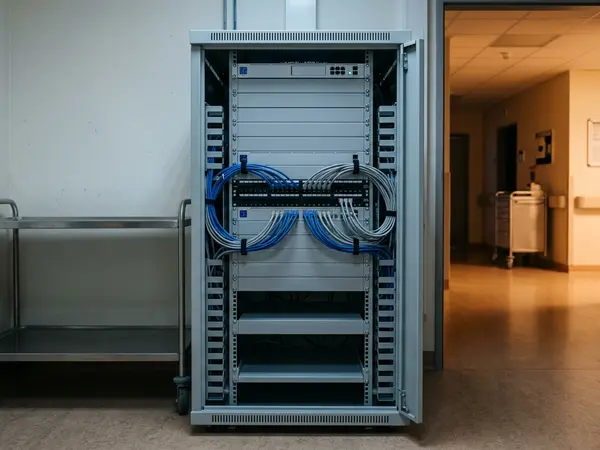
Bring us the systems you need to connect and what has to move between them. We'll come back with an interface plan, a timeline, and a fixed range — before anyone signs anything.
Book a scoping call or send us the details. If you also need the practice-side work, our managed IT and HIPAA compliance services cover it.

Managed IT, cybersecurity, HIPAA compliance, and AI automation for healthcare practices. We keep your technology secure so you can focus on patient care.

4MEDNET.COM - Copyright 2026. All rights reserved.