Cybersecurity: 24/7/365

Cybersecurity: 24/7/365
4MEDNET delivers managed IT, cybersecurity, HIPAA compliance, and AI automation solutions built exclusively for healthcare practices.



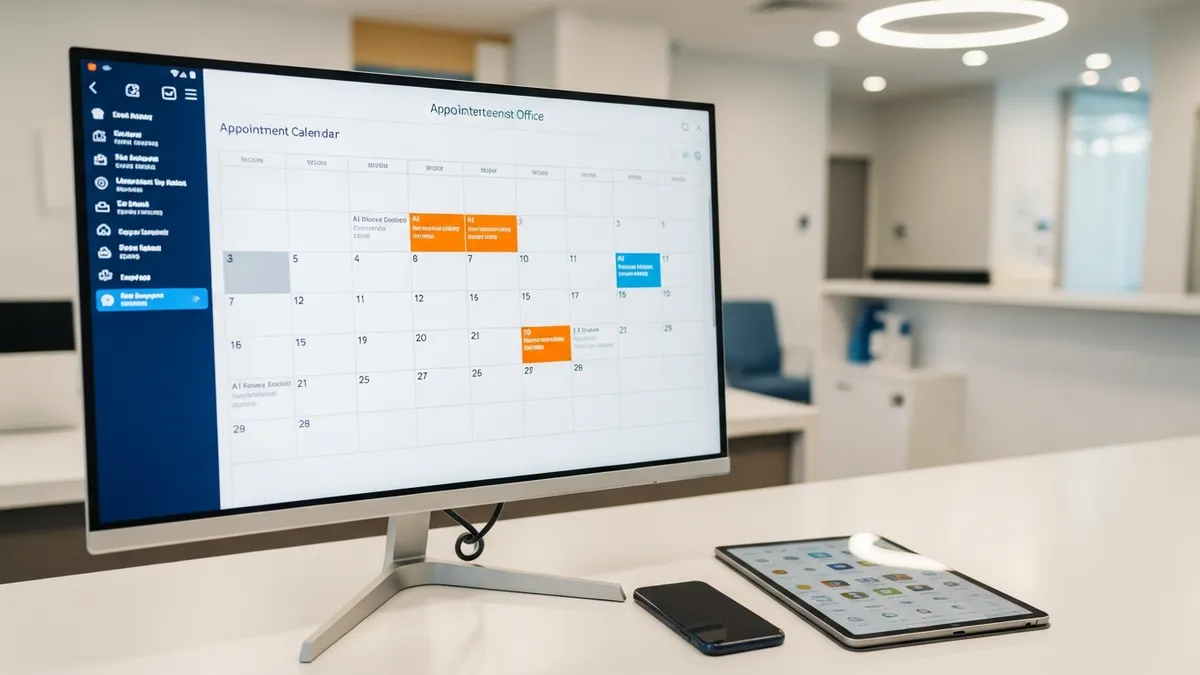
A primary care practice with 4 physicians handles 200+ scheduling calls every day. Each call takes 8 minutes on average — the patient explains what they need, the scheduler checks availability, offers times, negotiates, and books the slot. That is 26 hours of staff time per day spent on phone scheduling alone. Meanwhile, 23% of those calls go unanswered. 34% of patients who do get through hang up after 2 minutes on hold. And 62% will not leave a voicemail.
Every missed scheduling call costs $125-$200 in potential revenue. New patient calls are worth $300-$500. A practice missing just 10 scheduling calls per day loses $1,250-$2,000 daily — $312,000-$500,000 per year.
AI appointment scheduling eliminates this problem by letting patients book through voice, text, or web portals around the clock. The technology has moved well beyond simple online calendars. Today's AI scheduling systems understand natural language, predict no-shows, fill cancellations automatically, and integrate directly with your EHR. Here is how each piece works.
AI scheduling meets patients where they are — phone, text, or web — and handles the interaction the way a well-trained scheduler would.
Voice scheduling. The patient calls your office and speaks to an AI system that sounds like a person. No "press 1 for appointments" menus. The patient says, "I need to see Dr. Patel for a follow-up next week, preferably in the morning." The AI understands the request using natural language processing, checks Dr. Patel's availability for morning follow-up slots, and offers options. The patient picks a time. The AI books it, sends a confirmation text, and logs the appointment in your EHR — all within 60 seconds. Zocdoc launched its Zo voice AI for exactly this workflow: unlimited inbound scheduling calls, 24/7, with natural conversation that handles regional accents and speaking styles.
Text/SMS scheduling. Epic launched a conversational AI scheduling tool in 2025 that initiates SMS conversations in about 20 seconds. The system texts appointment options, the patient replies with their choice, and the booking is confirmed. No app downloads. No portal login. Just a text conversation. Currently live at 4 healthcare organizations, with more rolling out.
Self-scheduling portals. Web-based portals let patients browse available slots and book themselves. As of 2024, 63% of providers offer self-scheduling (up from 40% in 2022) and 89% of patients say the ability to schedule anytime with digital tools is important. One platform reports 87% patient adoption of online scheduling, with 45% of bookings happening after hours and 51% of online bookings coming from new patients.
Simple scheduling is just calendar math. AI scheduling is pattern recognition.
When a patient requests an appointment, the AI considers multiple variables simultaneously:
RPA bots complete the full scheduling-plus-registration workflow in 5 minutes, saving approximately 40 minutes per patient compared to manual processing. Healthcare providers using AI scheduling report 95% appointment accuracy and a 60% reduction in administrative scheduling time.
Cancellations create revenue holes in your schedule. Traditional waitlists rely on staff manually calling patients to fill openings — if they have time, which they usually do not. AI handles this automatically.
When a patient cancels, the AI system immediately:
One hospital saved an estimated $1 million per year by keeping schedules full through automated waitlist backfill. For a small practice, filling just 2-3 additional cancellation slots per day at $150 per visit recovers $75,000-$112,000 annually.
No-shows cost the U.S. healthcare system $150 billion per year. The average small practice loses $150,000+ annually to missed appointments. Two daily no-shows at $100 per visit add up to $50,000 per year. AI attacks this problem from two angles.
Predictive analytics. Machine learning models analyze historical data — prior attendance patterns, appointment types, demographics, time of day, and lead time between booking and visit — to predict which patients are most likely to miss their appointments. A 2025 study achieved 93.6% accuracy in no-show prediction. One implementation reduced no-show rates by 50.7%.
What practices do with these predictions:
Smart reminders. Automated text reminders reduce no-shows by 38%. Automated reminders through text and email can push no-show rates to 5% or less while increasing patient confirmations by over 150%. The cost: $0.15 per patient for automated texts versus $0.97 for manual phone calls.
83% of patients prefer reminders via text. Attendance increases 67% when providers use SMS. And the most effective programs use multi-channel reminders — text, email, and voice — timed at 72 hours, 24 hours, and 2 hours before the appointment.
40-60% of appointment bookings happen after business hours. Your phones are off at 5 PM, but your patients are on their phones at 9 PM. If you do not offer after-hours scheduling, you are invisible during peak booking time.
The numbers are stark: 41% of patient calls happen outside the 8 AM to 5 PM weekday window. 23% of weekly call volume falls on weekends. 38% of calls hit during the first and last hour of business — peak congestion when staff are least available to answer.
AI scheduling systems run 24/7. Patients book at midnight, on Sunday, and on holidays. AI after-hours answering captures calls that would otherwise go to voicemail — and remember, 62% of patients will not leave a voicemail. They will call your competitor instead.
One platform's data shows that 51% of online bookings come from new patients — people searching for a practice who book the moment they find one with available slots. After-hours availability means you capture patients your competitors lose overnight.
AI scheduling only works if it talks to your EHR in real time. Modern platforms connect through HL7/FHIR APIs for bi-directional data exchange. Building that link is FHIR integration work, and it is what decides whether bookings actually land in the chart. Tools that run inside the chart itself use SMART on FHIR. When a patient books through AI, the appointment appears instantly in your EHR calendar. When your staff blocks time or moves appointments in the EHR, the AI scheduling system reflects those changes immediately.
Major EHR integrations are well-established: athenahealth, Epic, eClinicalWorks, NextGen, and Practice Fusion all support direct connectors or interoperability frameworks like Carequality. If your EHR is on this list, integration is straightforward. Smaller or legacy EHRs may need custom API work — ask your vendor about specific connector availability before signing.
Any AI scheduling system that accesses patient information is a business associate under HIPAA. The 2025 HHS proposed regulation explicitly requires entities using AI tools to include them in risk analysis and risk management compliance activities.
Key requirements for HIPAA-compliant AI scheduling:
Staff must also be trained on which AI models may be used and the privacy implications — especially when generative AI handles patient-facing conversations. Verify that your vendor is HIPAA-compliant, SOC 2 certified, and provides a signed BAA before going live.
The aggregate data from practices using AI scheduling shows consistent returns:
Real-world case studies back up the aggregate data. One primary care network generated $6.2 million in additional revenue in year one through AI scheduling. A practice using smart confirmations reduced no-shows from 15.1% to 5.9% over two years, adding 145,000 appointments. A scheduling optimization program reduced cycle time from 67 to 42 minutes with an 892% first-year ROI.
For a small practice, the math is simpler: if AI scheduling fills 2-3 cancelled slots per day and reduces no-shows by 20%, the annual revenue recovery is $75,000-$150,000. Subtract the $3,600-$9,000 annual platform cost, and the net gain is $66,000-$146,000.
The AI scheduling market for healthcare is growing at 27.6% annually, from $63 million in 2024 to a projected $555 million by 2033. Platforms range from free (Zocdoc Practice Solutions) to enterprise pricing (Luma Health, Hyro). For small practices, look for these five things:
Start with self-scheduling and automated reminders — the two features with the fastest payback. Add voice AI and waitlist management in phase two. The entire implementation typically takes 4-8 weeks for basic features and 3-6 months for full optimization.
Book a free IT assessment to evaluate your scheduling workflow and identify where AI delivers the biggest return. We will analyze your no-show rates, call volume, and cancellation patterns to recommend the right platform and implementation plan. Explore our AI automation services and managed IT plans, or check out how AI phone systems cut no-shows by 40%.
Ready to take the next step? Explore our healthcare IT services, book a free consultation, or compare our plans.


Managed IT, cybersecurity, HIPAA compliance, and AI automation for healthcare practices. We keep your technology secure so you can focus on patient care.

4MEDNET.COM - Copyright 2026. All rights reserved.