Cybersecurity: 24/7/365

Cybersecurity: 24/7/365
4MEDNET delivers managed IT, cybersecurity, HIPAA compliance, and AI automation solutions built exclusively for healthcare practices.



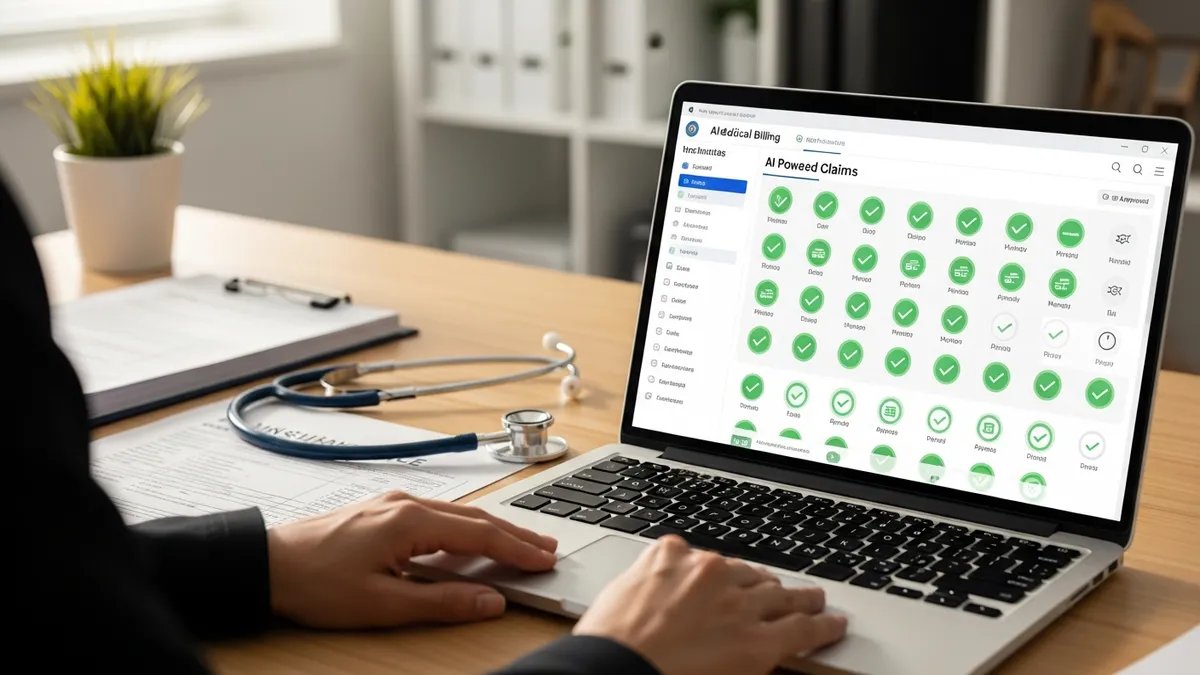
A two-physician family practice in Texas was collecting 82% of its billed revenue. Not terrible by industry standards. But on $1.5 million in annual billings, that missing 18% added up to $270,000 in lost revenue every year. Most of it was preventable: coding errors, eligibility mismatches, and claims that were denied once and never resubmitted.
The practice switched to an AI-powered billing platform. Within six months, their collection rate hit 96%. Denials dropped from 14% to under 6%. They recovered $210,000 in annual revenue they had been quietly losing. The billing staff went from spending half their day chasing denied claims to spending half an hour.
That is not a vendor success story from a sales deck. It is the pattern showing up across small practices that adopt AI billing tools. The question is not whether AI reduces denials. The data says it does. The question is whether the math works for your practice.
Initial claim denial rates hit 11.8% in 2024, up from 10.2% just a few years earlier. A 2025 Experian Health survey found that 41% of providers now report denial rates exceeding 10% — up from 30% in 2022. The trend is clear: payers are denying more claims, and the rules are getting more complicated.
For small practices, the numbers are even uglier. Practices with limited billing automation see denial rates of 15-20%, compared to the 5-7% benchmark for well-automated offices. About 30% of claims are denied on first submission. And here is the most painful statistic: 35-60% of denied claims are never resubmitted. That is revenue your practice earned but never collected.
Each denied claim costs $25-$181 to rework. Administrative costs per denial rose from $43.84 in 2022 to $57.23 in 2023. A practice billing $1.5 million annually with a 15% denial rate loses roughly $225,000 per year — and spends another $30,000-$40,000 in staff time chasing those denials.
The good news: 86% of denials are potentially avoidable. They stem from coding errors, eligibility issues, and documentation gaps — exactly the problems AI is designed to catch.
AI medical billing is not one product. It is a set of capabilities that address different failure points in your revenue cycle. Here is what each one does and why it matters.
AI-assisted coding. Natural language processing (NLP) reads clinical documentation and suggests the most accurate ICD-10, CPT, and HCPCS codes. AI cross-references clinical notes against more than 70,000 ICD-10-CM codes to find the right match. Current AI coding systems achieve accuracy rates above 95% for standard code sets. That matters because 43.9% of internal medicine visits and 33.9% of family practice visits are incorrectly coded when done manually.
Claim scrubbing. Before a claim goes out the door, AI scrubs it against payer-specific rules, checking for mismatches between diagnosis codes and procedure codes, missing modifiers, incorrect patient demographics, and bundling errors. Real-time scrubbing catches problems at the point of submission instead of weeks later when the denial arrives.
Denial prediction. Machine learning analyzes your historical claim data to identify which claims are at risk of denial before they are submitted. The system assigns risk scores based on patterns: specific payer behaviors, code combinations that trigger reviews, and documentation gaps that lead to rejections. Claims flagged as high-risk get reviewed before submission.
Eligibility verification. AI verifies patient insurance coverage in real time — checking active coverage, deductible status, copay amounts, and prior authorization requirements before the patient walks in. Eligibility-related denials drop by up to 70% with automated verification.
Charge capture. AI platforms sync with your EHR to pull all post-encounter data — clinical notes, charges, and payer rules — into a single system. This catches missed charges that would otherwise go unbilled and flags charges that do not match documentation.
Experian Health surveyed 250 healthcare professionals in 2025. Among the 14% who had implemented AI billing tools, 69% reported reduced denials and increased success on resubmissions. That is a strong signal — but the adoption gap is enormous. Only 14% have deployed AI, while 67% believe it would help.
Industry-wide performance data fills in the picture:
These are not theoretical projections. They come from practices that have already made the switch. Your results will depend on your current denial rate, practice size, payer mix, and how well the AI tool integrates with your existing systems.
AI medical billing exists on a spectrum. Most practices use AI-assisted coding, where the system suggests codes and flags errors, but a human coder reviews and approves every claim. This is the current standard — and it is the approach that produces the 95%+ accuracy rates cited above.
Fully automated billing — where claims go from documentation to submission without human review — is emerging but not mainstream. Even the most advanced platforms (like Fathom, which achieves 90%+ automation across specialties) keep human oversight in the loop for quality assurance.
For small practices, AI-assisted billing is the practical choice. You get the error reduction and speed gains without the risk of fully automated submissions. Your billing staff shifts from manual coding and data entry to reviewing AI recommendations and handling the 5-10% of claims that need human judgment.
AI billing platforms for small practices range from $99 to $600+ per provider per month, depending on features. Some platforms charge a percentage of collections instead of a flat fee. Watch for hidden costs: setup fees, training, data migration, and EHR integration can add $2,000-$10,000 to your initial investment.
Here is a realistic ROI calculation for a 2-provider practice billing $1.5 million annually:
Most practices see positive ROI within 6-9 months. Some achieve break-even in 60-90 days through immediate revenue recovery on claims that were previously denied and never resubmitted.
Denials that start upstream need fixing upstream. Our guide to prior authorization automation covers the CMS deadlines landing in 2026 and 2027, and where AI genuinely helps.
Any AI vendor that processes patient health information must comply with HIPAA. Before signing a contract, verify these requirements:
The proposed HIPAA Security Rule update eliminates the distinction between "required" and "addressable" safeguards. If it passes as expected, encryption, MFA, and annual compliance audits become mandatory for every covered entity. Practices that choose HIPAA-compliant AI tools now will already meet these requirements when the rule takes effect.
AI billing tools are not magic. They have real limitations:
Garbage in, garbage out. AI coding tools can only work with the documentation your providers write. If clinical notes are incomplete, the AI will suggest the best codes it can from incomplete information — and 63% of coding errors trace back to insufficient provider documentation. AI does not fix documentation problems.
Payer rules change constantly. AI models need continuous updates to reflect new payer policies, code changes, and regulatory requirements. A "set and forget" approach leads to accuracy degradation over time.
Integration is not instant. Connecting AI to your existing EHR and practice management system takes 4-12 weeks depending on complexity. Nearly 80% of providers rely on multiple solutions for claim submission, which means the integration challenge is real.
Staff training matters. Your billing team needs to learn how to work with AI recommendations, not just rubber-stamp them. Comprehensive training is the difference between 95% accuracy and 85%.
AI billing makes the most sense if your practice meets two or more of these criteria:
If your denial rate is already below 5% and your collection rate is above 95%, the ROI on AI billing will be modest. Focus your automation investment on other areas like AI phone systems or after-hours AI answering instead.
AI medical billing tools reduce denials. The data is consistent across surveys, industry reports, and vendor performance metrics. Practices that implement AI billing see denial rates drop by 40-60%, first-pass acceptance rates improve by 15-25%, and collection rates climb toward 95%+. The ROI math works for most small practices within 6 months.
But AI is a tool, not a solution. It works best when combined with good clinical documentation, proper staff training, and ongoing monitoring. The practices that get the best results treat AI as a force multiplier for their billing team — not a replacement for it.
Book a free IT assessment to evaluate your current billing workflow and identify where AI can recover lost revenue. We will analyze your denial patterns, recommend the right platform for your practice size and payer mix, and handle the integration with your EHR. Explore our AI automation services and managed IT plans to see how AI billing fits into your technology roadmap.
Ready to take the next step? Explore our healthcare IT services, book a free consultation, or compare our plans.


Managed IT, cybersecurity, HIPAA compliance, and AI automation for healthcare practices. We keep your technology secure so you can focus on patient care.

4MEDNET.COM - Copyright 2026. All rights reserved.