Cybersecurity: 24/7/365

Cybersecurity: 24/7/365
4MEDNET delivers managed IT, cybersecurity, HIPAA compliance, and AI automation solutions built exclusively for healthcare practices.



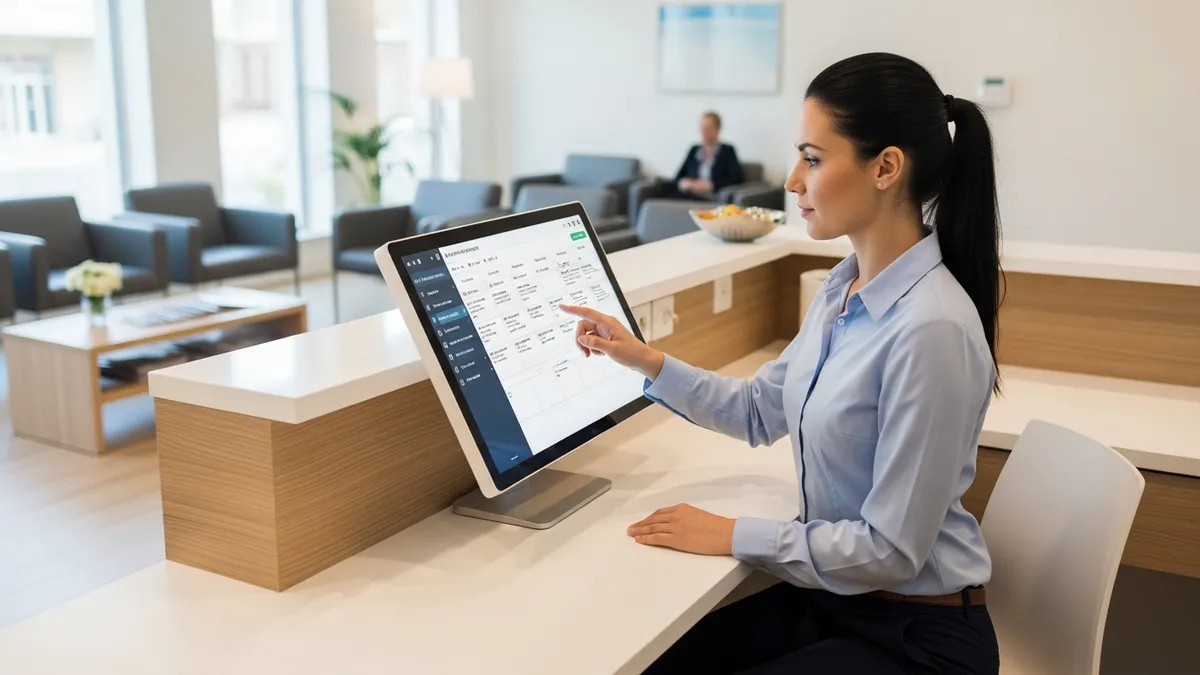
AI in healthcare isn't a future thing. It's a right-now thing. Practices across the country are using AI tools to cut hours of administrative busywork every week — freeing up staff for the work that actually requires a human.
You didn't go to medical school to chase down missed appointments, answer the same scheduling questions 40 times a day, or sort through IT tickets. Here are seven ways AI automation gives your practice that time back — starting with the one that makes the biggest difference.
Your front desk is the bottleneck of your entire practice. Phones ring constantly. Staff juggle incoming calls while checking in patients, verifying insurance, and answering questions from providers. During peak hours, calls go to voicemail. Patients hang up. Some call a different practice instead.
An AI receptionist answers every call on the first ring — no hold time, no voicemail, no missed opportunities. It handles the tasks that consume most of your phone traffic:
The AI speaks naturally. It doesn't sound like a phone tree or a robocall. Patients interact with it like they would with a receptionist — because that's what it is, minus the hold time and the lunch break.
Practices using AI receptionists report 35-50% reduction in front desk phone time. That's hours every day that your staff reclaims for in-person patient interactions. No-show rates drop 30-40% because every appointment gets confirmed automatically. And canceled slots get filled from your waitlist before the gap hits your revenue.
No-shows cost the average practice $200 per missed slot. For a busy clinic with 30 appointments per provider per day, that adds up to $150,000 or more per year in lost revenue. Phone calls from your front desk don't fix the problem — patients ignore calls from numbers they don't recognize.
AI-driven reminder systems send confirmations via text, email, and voice at the optimal time for each patient. They learn which patients respond to which channel. A patient who never opens email but always reads texts gets a text. A patient who responds better to a morning reminder than an evening one gets adjusted automatically.
When a patient cancels, the system immediately checks the waitlist and offers the slot to the next patient in line. No staff intervention required. The slot that would have been empty at 2 PM is filled by 10 AM.
Post-visit follow-ups happen automatically too — satisfaction surveys, post-procedure check-in messages, recall reminders for overdue patients, and reactivation outreach for patients who haven't been seen in 12+ months. Your staff used to do this manually with a spreadsheet. Now it runs in the background.
Paper intake forms waste everyone's time. Patients fill them out in the waiting room with a clipboard. Staff re-enters the data into the EHR. Handwriting gets misread. Fields get skipped. Insurance cards get photocopied and filed in a folder nobody looks at.
AI-powered digital intake sends forms to patients 48 hours before their visit via text or email. The system pre-populates known data from previous visits so returning patients don't re-enter their address and allergies every time. It flags incomplete fields before submission. It extracts insurance information from uploaded card photos using optical character recognition.
Your front desk reclaims 15-20 minutes per patient that used to go to data entry. Patients spend less time in the waiting room. Data accuracy improves because the patient enters information directly into structured fields instead of scribbling on a form. And the intake data flows into your EHR automatically — no double entry, no transcription errors.
For new patients, digital intake can collect medical history, current medications, consent forms, and HIPAA acknowledgments before the visit. The provider walks into the exam room with a complete chart instead of starting from scratch.
Traditional antivirus works like a wanted poster — it only catches threats it already knows about. AI-powered cybersecurity tools work differently. They learn what normal behavior looks like on your network and flag anything that deviates.
XDR (extended detection and response) uses AI to detect ransomware behavior patterns — mass file encryption, privilege escalation, lateral network movement — and contains the threat before it spreads. It doesn't need to recognize the specific malware. It recognizes what malware does.
AI-powered email security analyzes writing patterns, sender behavior, link destinations, and attachment characteristics to catch phishing emails that rule-based filters miss. As AI-generated phishing gets more sophisticated, only AI-powered detection keeps pace.
For your practice, this means threats get caught in seconds instead of hours or days. A phishing email that would have reached your front desk at 9 AM gets quarantined at 2 AM. A compromised workstation gets isolated before the attacker can reach your EHR. Your staff never sees the threat — they just see systems that keep working.
Your server doesn't crash without warning. It shows signs for days or weeks — rising temperatures, increasing error rates, degrading disk performance, memory pressure. The problem is that nobody watches for those signs until something breaks during patient hours.
AI monitoring tools watch your systems around the clock. They learn what "normal" looks like for your specific network and flag deviations early. A hard drive showing unusual read latency triggers an alert and a replacement before it fails on a busy Monday morning. A switch running hot gets attention before it drops your network.
Unplanned downtime costs healthcare practices an average of $7,900 per hour. Predictive maintenance catches 60-70% of potential failures before they cause outages. That's the difference between a scheduled 30-minute component swap on Saturday and an emergency all-hands-on-deck crisis during patient hours.
This is a core part of managed IT — your provider uses AI monitoring as the first layer of support, catching infrastructure problems before your staff notices anything is wrong. The best IT support is the kind you never have to call for.
HIPAA compliance isn't a once-a-year project. It requires continuous monitoring — access logs, training deadlines, policy reviews, vendor agreement renewals, patch status, and encryption verification. Most small practices track this in spreadsheets, if they track it at all.
AI compliance tools continuously scan your environment for gaps:
This doesn't replace your compliance officer or risk assessment process. It makes them ten times more effective. Instead of manually pulling reports and cross-referencing spreadsheets, your compliance effort focuses on real issues identified in real time.
Without automated monitoring, training deadlines slip through cracks. Vendor agreements expire without notice. When audit day arrives, the scramble begins. Automated monitoring turns a stressful annual fire drill into a calm, documented, always-current process.
When your printer jams and your EHR freezes on the same morning, both tickets land in the same queue. Without intelligent triage, they get handled first-come-first-served. The printer might get fixed while your EHR stays down for an hour — costing you thousands in lost productivity.
AI triage reads incoming support requests, categorizes them by urgency and system impact, and routes them to the right technician. An EHR outage affecting patient care jumps to the front of the queue. A password reset redirects to the self-service portal for immediate resolution. A network connectivity issue routes to your network specialist, not your desktop technician.
AI-powered self-service portals handle the simple requests that consume disproportionate IT time: password resets, VPN connection guides, printer troubleshooting steps, and software access requests. Staff get instant answers instead of waiting in a ticket queue. Your IT team focuses on problems that actually require human expertise.
The result: average ticket resolution time drops 25-40%. Urgent issues get addressed in minutes instead of hours. Your clinical staff spend less time waiting on IT and more time with patients.
Every AI automation in this list has a compliance benefit that goes beyond efficiency:
AI doesn't just save time. It reduces the number of places where PHI can leak, get lost, or be mishandled. Fewer manual touchpoints means fewer opportunities for human error — which is the root cause of most HIPAA violations.
Related: see whether AI billing really reduces denials.
You don't need to automate everything at once. Start with the area that causes the most pain. For most practices, that's phone handling and appointment management — the AI receptionist delivers measurable ROI within the first month.
Before you roll any of this out, decide the rules in writing — a short AI policy keeps staff from pasting chart notes into whatever chatbot they found first.
The key is choosing tools built for healthcare. Generic business automation doesn't understand HIPAA, HL7, or clinical workflows. You need solutions designed for medical practices and configured by people who know your world.
Check our pricing page to see how AI automation fits into your plan, or book a consultation and we'll map out which automations save your practice the most time and money. We'll assess your current workflows, identify the biggest opportunities, and implement without disrupting patient care.
Questions? Reach out to our team. We'll show you exactly what AI can do for a practice like yours.
Ready to take the next step? Explore our healthcare IT services, book a free consultation, or compare our plans.


Managed IT, cybersecurity, HIPAA compliance, and AI automation for healthcare practices. We keep your technology secure so you can focus on patient care.

4MEDNET.COM - Copyright 2026. All rights reserved.