Cybersecurity: 24/7/365

Cybersecurity: 24/7/365
4MEDNET delivers managed IT, cybersecurity, HIPAA compliance, and AI automation solutions built exclusively for healthcare practices.



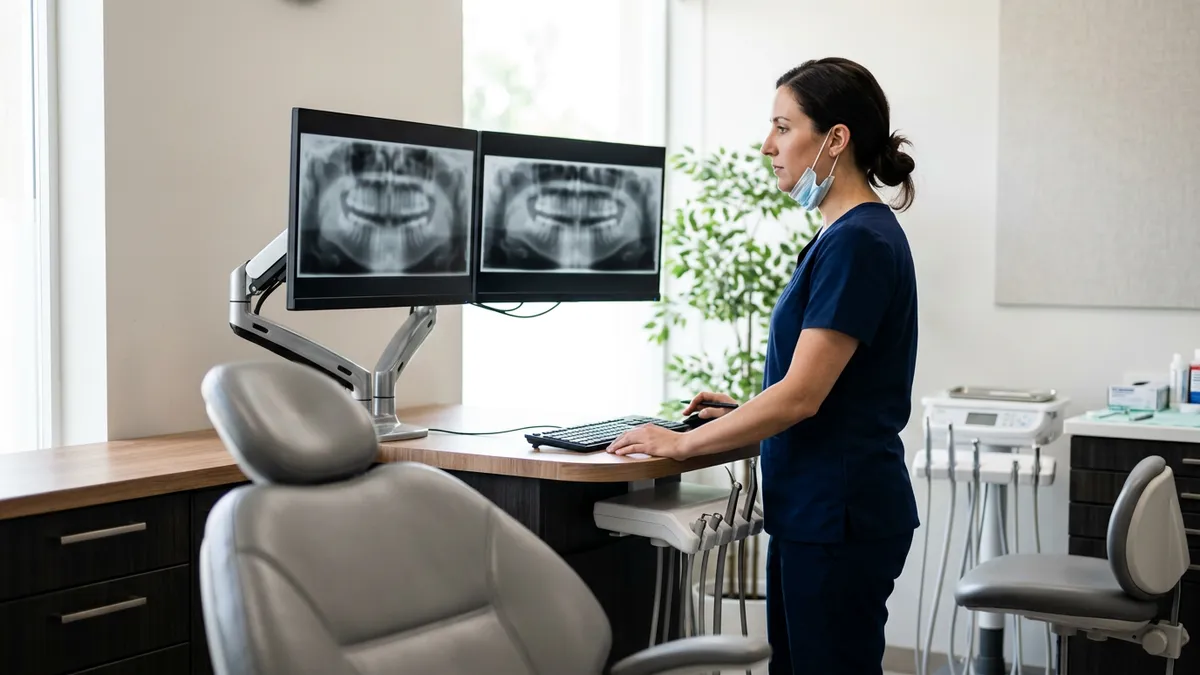
Every dental AI vendor says its product is "FDA cleared." That is true, and it tells you almost nothing. One product is cleared to find caries on bitewings in adults only. Another covers children from age four. A third reads CBCT scans but not intraoral films. The clearance number is where the real differences are.
Artificial intelligence is now routine in dental imaging software, and the choice of product shapes your daily workflow. We read the FDA 510(k) records for every dental x-ray AI product we could find, using FDA data current to October 26, 2026. This guide compares what each one is actually cleared to do, so you can match a product to your images and your patients. For how the technology works and what to ask before buying, start with our dental AI x-ray analysis guide.
Cleared is not the same as approved. Moderate-risk Class II devices reach the market through 510(k) clearance, by showing they are substantially equivalent to a device already on the market. Approval is the process for the highest-risk Class III devices. Every dental x-ray AI product below is a Class II 510(k) device, so "FDA-approved" would be inaccurate for all of them.
Four details in each clearance matter in practice:
FDA also uses two product codes here. Detection aids that flag suspected disease use code MYN. Tools that measure, segment or chart use code QIH. A product cleared only under QIH measures and labels, but it does not flag disease.
You can check any claim yourself. Search the clearance number in FDA's 510(k) database and read the Indications for Use statement.
| Vendor | Caries (bitewing/periapical) | Periapical radiolucency | Bone levels | Panoramic findings | CBCT | Youngest patients for caries |
|---|---|---|---|---|---|---|
| Overjet | Yes | Yes (periapical) | Yes | Charting only | Segmentation and measurement | 4 |
| Pearl | Yes | Yes | Yes | Yes, ages 16+ | Anatomy | 4 |
| VideaHealth | Yes | Yes | Yes | Past treatments and anatomy only | None | 3 |
| Diagnocat | None | CBCT only, ages 22+ | None | None | Yes | Not cleared |
| Denti.AI | Yes | Yes | Yes | Extraoral 2D images | None | 22 |
| DEXIS (DTX Studio) | Yes | Yes | Yes | None | None | 15 |
| VELMENI | Yes | None | Yes | Yes, ages 15+ | Anatomy | 15 |
"Yes" means at least one clearance covers that finding or image type. The details below give the clearance numbers and the limits that apply to each.
Overjet's first clearance, Dental Assist (K210187), was issued on May 19, 2021 for measuring bone levels. It has added detection clearances steadily since:
Overjet also has a clearance for an imaging system that flags capture problems such as cone cuts and overlapping contacts (K253930, April 2026). That one is image management, not a diagnostic aid.
Pearl's Second Opinion (K210365, March 4, 2022) is a second reader for bitewing and periapical radiographs of permanent teeth, in patients 12 and older. It marks caries, periapical radiolucency, calculus, margin discrepancies on restorations, and existing work such as crowns, fillings, root canals, bridges and implants.
Pearl added seven clearances in 2025:
Pearl says it integrates natively with Open Dental's imaging module and is an authorized vendor in the Henry Schein One API Exchange for Dentrix and Dentrix Ascend. Those are vendor claims; confirm them for your exact versions.
VideaHealth's Caries Assist (K213795, April 2022) covers bitewings in adults 22 and older. Perio Assist (K223296, February 2023) measures bone levels on bitewing and periapical images.
Its broadest clearance, Dental Assist (K232384, December 2023), flags ten suspected findings, including caries, calculus, periapical radiolucency and furcation involvement. It is cleared for patients 3 and older, the youngest age limit we found. A September 2025 update, Videa Dental AI (K251002), keeps the same indications.
One limit is easy to miss. On panoramic images, the clearance covers past treatments and normal anatomy only, which FDA's summary says are not diagnostic aids. Suspected findings such as caries are cleared on bitewing and periapical images, not panoramics.
Diagnocat's US clearances are CBCT only. Its viewer (K251072, September 2025) handles viewing and 3D visualization. Its detection clearance (K252934, January 2026) flags periapical radiolucency on permanent teeth in adults 22 and older, on CBCT scans already taken for another reason.
That clearance also requires users with at least two years of CBCT reading experience. We found no FDA clearance for Diagnocat's analysis of intraoral or panoramic images.
Denti.AI has two clearances, both for adults 22 and older with no primary teeth. Auto-Chart (K222054, November 2022) identifies teeth and existing restorations for charting. Detect (K230144, October 2023) is a second reader that flags caries and periapical radiolucency and measures bone levels on intraoral and extraoral 2D images.
Some products marketed in this space did not appear in FDA's database. Align's X-ray Insights launch release in March 2025 said US clearance was still pending, and we found no Align 510(k) for x-ray analysis. If a vendor cannot give you a clearance number, treat the product as not cleared in the US.
Pediatric clearances are newer and fewer. As of our review, these cover caries detection in children:
Most other products are cleared from 12, 15, 18 or 22. Using one on a younger patient is outside its clearance.
The right product depends on the dentistry you actually do and the dental care your patients need, not on the longest feature list.
Then treat the vendor like any other service that handles patient data. Radiographs are protected health information, so you need a signed Business Associate Agreement and a clear answer on whether your images train their models. Our vendor risk management guide and our guide to whether AI is HIPAA compliant cover the questions.
An FDA clearance covers specific findings, images and ages, and nothing more. Building or adapting AI that interprets images yourself is a different matter, covered in our explainer on FDA rules for clinical decision support software.
The imaging PCs that run these tools need protecting too. Our dental practice cybersecurity guide covers them. If you want help comparing vendors against your systems or connecting the software to them, our AI automation services work with dental practices.
Ready to take the next step? Explore our healthcare IT services, book a free consultation, or compare our plans.





Managed IT, cybersecurity, HIPAA compliance, and AI automation for healthcare practices. We keep your technology secure so you can focus on patient care.

4MEDNET.COM - Copyright 2026. All rights reserved.